|
LIVESTOCK NUTRITION SUPPLIES
July Edition
ZINC: THE QUIET DRIVER OF STRESS RESILIENCE, GAIN, AND CARCASS QUALITY
Why this small trace mineral deserves a big place in your mineral program
Zinc rarely gets the attention that copper or selenium do, yet pound for pound it may be the hardest-working trace mineral in the bunk. Zinc is a required cofactor for more than 200 enzyme systems in cattle, touching everything from immune defense and skin/hoof integrity to protein synthesis and reproduction. When zinc status slips — even before visible deficiency symptoms appear — cattle become measurably less resilient to stress and less efficient at converting feed into gain. This newsletter takes a closer look at why zinc deserves a permanent, well-balanced place in your mineral program.
ZINC AND STRESS: HEAT, TRANSPORT, AND BEYOND
Heat Stress
Heat-stressed cattle experience oxidative stress at the cellular level, and the gut lining is often the first tissue to suffer. Zinc supports tight-junction proteins that keep the intestinal barrier intact; when that barrier weakens under heat load, cattle become more prone to leaky gut, inflammation, and reduced intake. Research on heat-stressed intestinal tissue has shown that supplemental zinc helps protect antioxidant status, tight-junction integrity, and reduces inflammatory signaling under heat challenge — supporting cattle through the hottest stretches of summer.
Transportation and Shipping Stress
Weaning, hauling, and comingling stack multiple stressors on newly received cattle at once, and this is exactly where zinc status has been studied the most. Feedlot receiving trials have consistently shown that cattle supplemented with adequate, bioavailable zinc mount a stronger immune response and show reduced duration of clinical signs from shipping-related respiratory disease and scours compared with zinc-marginal counterparts. Organic trace mineral programs (zinc included) fed to shipping-stressed calves have also been shown to improve gain-to-feed efficiency over inorganic-only programs during the receiving period.
Other Stressors: Weaning, Disease Challenge, and the Transition Period
Zinc's role isn't limited to heat and hauling. In dairy cattle, the transition period around calving is one of the most immunologically demanding windows in the production cycle, and trace mineral complexes including zinc have been shown to help cows better withstand the combined metabolic and heat stress load of that period. In preweaning calves, zinc supplementation (particularly zinc-methionine) has been associated with reduced incidence and duration of diarrhea, a leading cause of early-life stress and setback.
ZINC, GAIN, AND CARCASS QUALITY
Dietary zinc — regardless of source — has repeatedly been shown to support growth during the growing period, and the effect is magnified in stressed or marginal cattle. In a feedlot receiving study out of Iowa State, organic trace mineral programs improved overall gain-to-feed ratio by roughly 12-20% compared to an inorganic-only control, even in cattle that started the trial with adequate liver and plasma zinc status. In grazing beef heifers, a copper-zinc supplement ahead of breeding improved weight gain and antioxidant status.
On the carcass side, zinc's role in protein synthesis and muscle development links it directly to lean growth, while its antioxidant function helps protect muscle tissue quality through the finishing period and into the cooler. Cattle that go into the feedlot or grazing season with a marginal zinc status are working with a nutritional handicap before they ever hit the scale.
For lactating dairy cows, zinc requirements go up substantially to support milk synthesis, udder health, and hoof integrity under the mechanical stress of concrete and high-production demands. Elevated zinc-methionine supplementation in high-producing Holsteins has been shown to support antibody and antioxidant enzyme status while helping maintain milk production performance. Zinc is also central to keratin formation in the hoof wall and teat-end skin, both frontline barriers against environmental mastitis and lameness — two of the most expensive problems in any dairy operation.
Combined with copper, manganese, and selenium, zinc supplementation through the transition period has been associated with improved reproductive performance and better tolerance of the metabolic and heat stress load that surrounds calving.
BUILDING A BALANCED PROGRAM: SYNERGISTS AND ANTAGONISTS
Zinc doesn't work in isolation — it is part of a web of mineral interactions in the rumen, gut wall, and liver. A mineral program that ignores those interactions can under-deliver even when the tag says the zinc level is adequate.
Works Well With Zinc
|
Nutrient
|
Why It Pairs Well With Zinc
|
|
Vitamin A
|
Supports the same epithelial and skin/hoof integrity pathways zinc relies on; the two are frequently deficient together.
|
|
Vitamin E & Selenium
|
Share antioxidant duty with zinc in fighting oxidative stress from heat, transport, and disease challenge; commonly paired in transition and receiving programs.
|
|
Manganese
|
Works alongside zinc in reproductive and enzyme function; balanced Zn:Mn levels support fertility programs.
|
|
Methionine (as Zn-Methionine)
|
An organic "chelated" form that shields zinc from competing for absorption, improving bioavailability over straight zinc sulfate or oxide.
|
|
Copper (at balanced ratios)
|
Both are needed together for many enzyme systems; the key is ratio, not exclusion — see antagonist note below.
|
Works Against Zinc
|
Antagonist
|
How It Interferes
|
|
Excess Calcium
|
High dietary calcium — common in calcium-heavy mineral or legume-based rations — depresses zinc absorption in the gut.
|
|
Excess Iron
|
High iron intake, including iron-heavy water sources, competes with zinc for shared absorption pathways.
|
|
Excess Copper (or excess Zinc)
|
Zinc and copper compete for the same absorption routes; too much of either can suppress status of the other. Ratio matters more than raw quantity.
|
|
Phytate (grain- and legume-heavy diets)
|
Phytic acid in high-concentrate or legume-heavy diets can bind zinc in the gut, reducing what's actually absorbed.
|
|
High Sulfur / Molybdenum Diets
|
While their primary antagonism targets copper, high-sulfur and high-molybdenum situations complicate the whole Cu-Zn-Fe-S mineral balance and warrant a mineral profile review.
|
PUTTING IT INTO PRACTICE: LNS #9 TRACE MINERAL
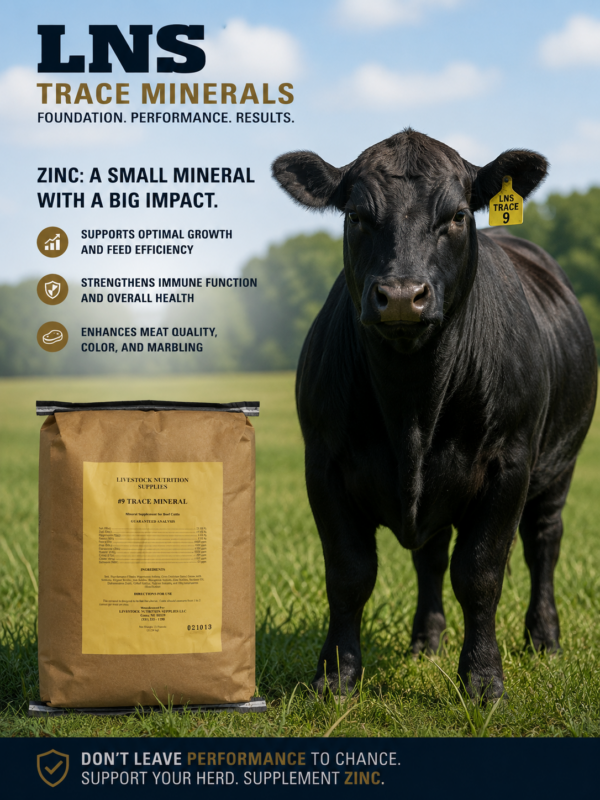
This is exactly the balancing act LNS #9 Trace Mineral was built to handle. It's a free-choice, salt-based trace mineral supplement formulated for beef cattle, dairy cattle, deer, and goats, delivering 3,600 ppm zinc alongside a full supporting cast of trace minerals — not zinc in isolation — so it corrects the marginal zinc status that so often sits behind “slightly off” performance: rougher hair coats, more sickness after a hard haul, slower gains through a stretch of heat.
Guaranteed Analysis
|
Nutrient
|
Guaranteed Level
|
|
Salt
|
73.00 – 77.00 %
|
|
Magnesium (Min)
|
0.50 %
|
|
Sulfur (Min)
|
1.70 %
|
|
Zinc (Min)
|
3,600 ppm
|
|
Copper (Min)
|
5,000 ppm
|
|
Manganese (Min)
|
4,100 ppm
|
|
Iron (Min)
|
5,000 ppm
|
|
Iodine (Min)
|
222 ppm
|
|
Cobalt (Min)
|
1,100 ppm
|
|
Selenium (Min)
|
51 ppm
|
Ingredients: Salt, Bicarbonate of Soda, Magnesium Sulfate, Corn Distillers Dried Grains with Solubles, Copper Sulfate, Iron Sulfate, Manganese Sulfate, Zinc Sulfate, Soybean Oil, Diatomaceous Earth, Cobalt Sulfate, Sodium Selenite, and Ethylenediamine Dihydriodide.
Note the copper (5,000 ppm) and manganese (4,100 ppm) levels sitting right alongside zinc — that's the ratio balance the synergist/antagonist table above is about. #9 Trace Mineral also carries selenium (51 ppm), which pairs with zinc's antioxidant role during heat and transport stress, and a full 222 ppm of iodine and 1,100 ppm cobalt to round out the trace package. Sulfur is held to a modest 1.70%, low enough that it isn't fighting the copper and zinc for absorption the way a high-sulfur co-product ration can.
● Supports stress resilience through hauling, weaning, and heat, when zinc demand climbs fastest.
● Provides a balanced trace mineral base — zinc, copper, manganese, selenium, iodine, and cobalt together — to build a growing, receiving, or lactating-cow program on, rather than guessing at individual mineral additions.
● Contains added copper (5,000 ppm) — do not feed to sheep or other species with low copper tolerance.
As with any mineral program, free-choice intake should be monitored and dosage cross-checked against the rest of your ration — run it through LNAS.pro or give us a call and we'll help you dial it in.
|
THE LNS TAKEAWAY
Zinc status is easy to overlook because deficiency rarely announces itself with a single obvious symptom — it shows up as slightly more sickness after hauling, slightly slower gains, slightly rougher hair coats, and slightly higher somatic cell count. A well-balanced, properly ratioed mineral program is cheap insurance against all of it. Run your current mineral program through LNAS.pro to check zinc levels against NRC requirements for your class of cattle and see how nearby minerals are ratioed against it.
|
Questions? Ready to build your summer supplement program?
Livestock Nutrition Supplies LLC • Crete, Nebraska
Info@LivestockNutitionSupplies.com • lnas.pro
livestocknutritionsupplies.com
Disclaimer:
This newsletter is provided for educational and informational purposes and reflects general industry knowledge and current publicly available information. |