|
LIVESTOCK NUTRITION SUPPLIES
June Edition
Fighting Flies, Ticks, Mosquitoes & More
The Case for All-Natural, Multi-Layer Protection
For Cattle, Horses, Sheep, Goats & All Livestock
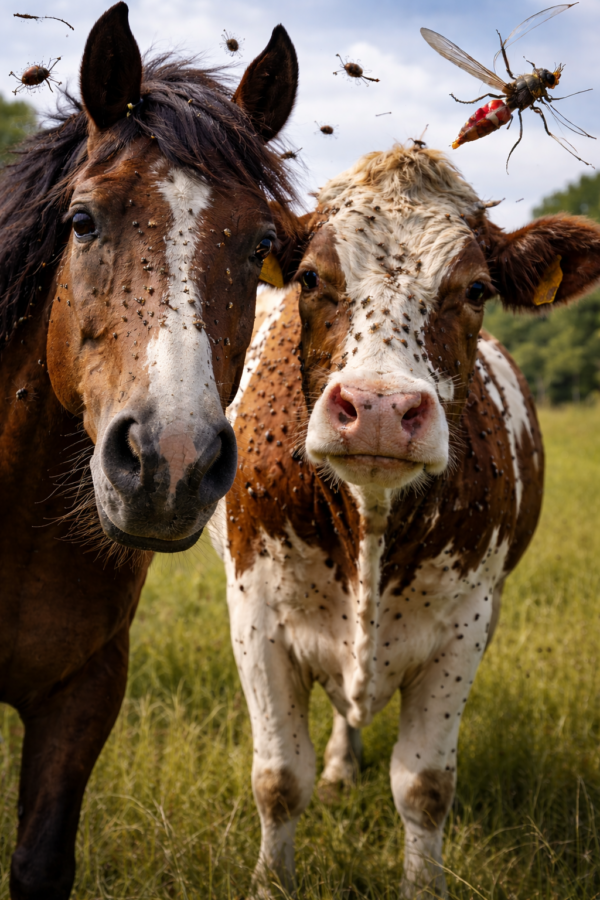
Summer brings green grass, longer days — and an onslaught of ectoparasites. Flies, ticks, and mosquitoes are not merely a nuisance. They are a direct tax on your operation’s productivity, costing the U.S. beef industry an estimated $2.2 billion per year in lost performance and treatment costs. And in the summer of 2025, a new and more serious threat has re-emerged on U.S. soil for the first time in decades.
At Livestock Nutrition Supplies, we hear from producers who have relied on conventional chemical treatments for years and are frustrated with diminishing returns, resistance problems, and growing concerns about residues and withdrawal times. The good news: a well-designed, all-natural Integrated Pest Management (IPM) program can be just as effective — and in most cases more sustainable — as a chemical-dependent approach. This newsletter lays out the full threat landscape and a practical framework for protecting every animal on your operation naturally.
|
⚠️ URGENT ALERT FOR ALL LIVESTOCK PRODUCERS
New World Screwworm: A National Emergency Has Arrived
On June 3, 2026, the USDA confirmed the first detection of New World Screwworm (Cochliomyia hominivorax) in U.S. livestock in decades — a 3-week-old calf in Zavala County, Texas. This is not a distant threat. It is here, and every livestock producer in the United States needs to be informed and prepared.
The USDA has classified NWS as a national security issue. U.S. Sec. of Agriculture Brooke Rollins stated: "It is not only a threat to our ranching community — but it is a threat to our food supply and our national security."
What to watch for: wounds that enlarge or fail to heal, foul odor from wounds, visible maggots or fly eggs near body openings (nose, ears, genitalia, navel of newborns), signs of pain or agitation.
If you suspect NWS in any animal: Contact your state animal health official or USDA area veterinarian immediately. Do NOT attempt to self-treat a suspected NWS case. For more information: screwworm.gov
|
Know Your Enemy: The Full Threat Landscape
Horn Flies & Face Flies
Horn flies (Haematobia irritans) are the most economically damaging pest of pasture cattle in North America. A single cow may carry 200 to 4,000 horn flies at any given time, with each female feeding up to 30 times per day. Research consistently shows horn fly populations above 200 per animal cause measurable losses in average daily gain, ranging from 15 to 50 pounds per animal per season — directly cutting into profitability at sale.
Face flies (Musca autumnalis) cluster around eyes, nostrils, and wounds — spreading infectious bovine keratoconjunctivitis (IBK), more commonly known as pinkeye. A single pinkeye case can cost $150 to $300 in treatment, reduced gain, and potential calf death loss. Face flies are also a critical concern in the context of New World Screwworm: face flies visit open wounds and mucous membranes, which are the same sites NWS flies target for egg-laying. Reducing face fly pressure reduces the overall fly activity around vulnerable wound sites on your animals.
Horses and ponies are highly susceptible to stable flies and face flies, which cause agitation, interrupted grazing, and weight loss. In dairy operations, fly pressure directly reduces milk production through stress responses and teat irritation.
New World Screwworm (Cochliomyia hominivorax)
New World Screwworm is categorically different from every other pest discussed in this newsletter. Where horn flies, face flies, and stable flies feed on blood or secretions, NWS larvae (maggots) invade and consume the living tissue of warm-blooded animals. Once eggs hatch in a wound or body opening, larvae burrow deeper using sharp mouth hooks — the "screwing" motion that gives the fly its name — feeding on living flesh as they go. Without treatment, an infested animal can die within one week.
The NWS fly (Cochliomyia hominivorax) was eradicated from the United States in 1966 through a landmark sterile insect technique (SIT) program — one of the greatest achievements in American agricultural history. Since 2023, however, the parasite has been re-emerging northward through Central America and Mexico, and on June 3, 2026, USDA-APHIS confirmed the first U.S. livestock case in Zavala County, Texas.
Every species of warm-blooded animal is susceptible: beef cattle, dairy cattle, horses, sheep, goats, hogs, dogs, cats, and in rare cases, people. Animals at the highest risk include:
• Newborns with fresh umbilical cords (the umbilical area is a primary NWS oviposition site)
• Animals with any open wound, including post-dehorning, branding, castration, ear notching, or tail docking sites
• Animals with tick wounds, fight wounds, barbed wire injuries, or foot rot
• Females post-parturition with birth canal or udder injuries
• Animals with pinkeye lesions or other mucous membrane irritation
The economic stakes are enormous. Before eradication, NWS cost U.S. cattle producers hundreds of millions of dollars annually. A re-establishment of NWS in the southern United States would affect not only affected operations but the entire domestic livestock market, supply chains, and export eligibility.
Ticks
Multiple tick species affect livestock across the Plains and Midwest, including the lone star tick, the American dog tick, and the Gulf Coast tick. Ticks transmit anaplasmosis, theileriosis, and Rocky Mountain spotted fever. In cattle, a heavy anaplasmosis outbreak can result in mortality rates of 30 to 50 percent in unvaccinated, highly susceptible animals.
Ticks also have a direct connection to NWS risk: tick bite wounds create exactly the kind of small, open skin lesions that NWS flies can exploit for egg-laying. Controlling tick burden on your livestock is not just about anaplasmosis prevention — in 2025 and beyond, it is also a frontline defense against screwworm infestation.
Sheep and goats face intense tick burden risk as well, with ticks capable of causing tick paralysis in young lambs and kids. Horses suffer from tick-borne conditions including equine piroplasmosis and Lyme disease.
Mosquitoes
Mosquitoes are vectors for Epizootic Hemorrhagic Disease (EHD), bluetongue virus, and West Nile virus. EHD primarily devastates white-tailed deer populations, but cattle and sheep can be affected in endemic areas. West Nile virus is a serious and potentially fatal threat to horses. Beyond disease transmission, mosquito pressure alters behavior across all livestock species, reducing grazing time, feed efficiency, and average daily gain.
|
📊 The Financial Reality for Cattle Producers
Horn flies: $876 million in estimated annual losses (USDA) — performance, stress, reduced intake
Anaplasmosis (tick-transmitted): $300+ million annually in treatment, death loss, and lost productivity
Pinkeye (face fly-transmitted): $150–$300 per case in treatment and associated production loss
New World Screwworm: potential for billions in losses if re-established — prior to eradication, NWS cost the U.S. cattle industry hundreds of millions annually; modern herd values and market interdependencies make re-establishment far more costly today
Mosquito-borne diseases (EHD, West Nile in horses): mortality and treatment costs highly variable but significant
Combined summer pest pressure: studies show 5–10% reduction in overall herd ADG in untreated herds during peak fly season
|
Why Chemical-Only Programs Break Down
For decades, the default response to ectoparasite pressure has been synthetic insecticides: pyrethroid pour-ons, organophosphate ear tags, and synthetic spray programs. Used as a sole defense, they set the stage for failure in three predictable ways.
1. Resistance Development
Pesticide resistance is not a future risk — it is a present reality. Pyrethroid resistance in horn fly populations has been confirmed across the United States, including throughout Nebraska and surrounding states. Some local populations now carry resistance to multiple insecticide classes simultaneously. With horn flies completing a full life cycle in as little as 10 to 14 days during summer, a resistant population can dominate your pastures within a single season.
2. Sub-Lethal Exposure Accelerates Resistance
Leaving insecticide ear tags on cattle past the end of fly season, or allowing pour-ons to weather down to sub-lethal concentrations, is arguably more damaging than no treatment in terms of resistance selection. Flies exposed to doses that do not kill them are the most likely to survive, reproduce, and produce resistant offspring.
3. Residue, Withdrawal & Market Concerns
Chemical ectoparasite controls carry withdrawal times that affect market eligibility for beef and dairy. Producers targeting natural, grass-finished, or certified organic markets face additional scrutiny. Export markets with strict residue standards also create strong economic incentives to minimize or eliminate synthetic chemical use.
|
💡 Note on NWS Treatment
New World Screwworm is a special case requiring immediate veterinary involvement. If NWS is confirmed or suspected, follow your veterinarian’s guidance on FDA-authorized treatments — this is not a situation for home remedies or natural-only management. That said, the natural and cultural practices in this newsletter are your most powerful tools for PREVENTING NWS from gaining a foothold on your operation in the first place.
|
Building Your All-Natural IPM Program
Integrated Pest Management (IPM) means using multiple tools with different modes of action to control pest populations from several angles simultaneously. When your tools are all natural, the benefits compound: no resistance development, no withdrawal concerns, no chemical residues, and a program that grows more effective over time.
Natural Ectoparasite Control Reference Guide
|
Method
|
Target Pests
|
How It Works
|
Livestock
|
|
Garlic Supplementation
|
Horn flies, face flies, ticks, mosquitoes, NWS (repellent/fly deterrent)
|
Allicin/allyl sulfides excreted through skin — systemic repellent; deters fly oviposition
|
All species
|
|
Diatomaceous Earth (DE)
|
External parasites, flies, lice
|
Mechanical: damages insect exoskeleton; can be applied topically or in feed
|
Cattle, horses, sheep, goats, hogs
|
|
Wound Care & Hygiene
|
NWS (critical), blowfly strike, secondary infection
|
Eliminates oviposition sites; clean wounds do not attract screwworm flies
|
All species
|
|
Essential Oil-Based Repellents
|
Mosquitoes, stable flies, face flies
|
Volatile aromatic compounds deter landing, feeding, and egg-laying
|
All species
|
|
Dung Beetle Conservation
|
Horn flies (larvae)
|
Destroys fly breeding habitat naturally
|
Cattle, horses
|
|
Parasitic Wasps
|
Horn flies, stable flies (pupae)
|
Parasitize fly pupae before adult emergence
|
Cattle, horses, hogs
|
|
Rotational Grazing
|
All ectoparasites
|
Removes livestock from contaminated/high-pressure areas; breaks pest cycle
|
Cattle, horses, sheep, goats
|
|
Manure Management
|
Horn flies, stable flies
|
Eliminates primary breeding habitat
|
All species
|
|
Fly Traps & Physical Barriers
|
Mosquitoes, stable flies, gnats
|
Mechanical exclusion and trapping
|
All species; especially horses and dairy
|
|
Postponing Wound Procedures*
|
NWS prevention (critical)
|
Dehorning, branding, castration, tail docking in NWS risk areas should be timed and wounds immediately managed
|
All species
|
|
Probiotic Supplementation
|
Indirect — immune system support
|
Supports gut health and systemic immune defense against pest-transmitted disease
|
All species
|
|
Vitamin A, D & E Supplementation
|
Face fly-transmitted pinkeye (IBK)
|
Maintains ocular mucosal immunity; reduces susceptibility to pest-transmitted disease
|
Cattle, sheep, goats, horses
|
* In NWS-endemic or risk areas, consult your veterinarian before scheduling dehorning, branding, castration, or other wound-creating procedures. If procedures must be performed, treat resulting wounds immediately with appropriate products and monitor closely.
Layer 1: Environmental & Habitat Management
The most powerful and least expensive layer of any IPM program is habitat management. Remove the environment pests need to breed, and you reduce populations before they ever reach your animals.
• Manure management is the single most impactful horn fly and stable fly control measure available. Horn fly larvae only develop in undisturbed cattle manure deposited on pasture. Frequent spreading disrupts the breeding cycle significantly.
• Eliminate standing water wherever possible to reduce mosquito breeding. Even small volumes accumulating in shaded areas can support substantial mosquito populations within days.
• Rotational grazing moves livestock away from heavily contaminated pastures, breaking the pest’s habitat and host-finding cycle simultaneously. This practice benefits forage utilization, soil health, and parasite management across all livestock species.
• Manage brush and tall grass around handling facilities, shade structures, and water sources to reduce tick habitat.
• Ventilation in barns and stables reduces stable fly, house fly, and gnat pressure. Fans create air movement that disrupts insect flight behavior.
• Minimize open wounds whenever possible. Barbed wire hazards, sharp equipment, and rough handling that causes skin abrasion all create NWS oviposition opportunities. Inspect fencing and facilities regularly. Every wound on every animal is a potential entry point.
Layer 2: Wound Care — Your Most Critical NWS Defense
In the context of New World Screwworm, wound care is not optional — it is a biosecurity imperative. NWS flies are attracted to fresh wounds, birth fluids, and mucous membranes. A clean, covered wound does not attract screwworm flies. A neglected, open wound is an invitation.
Natural wound care practices that reduce NWS and blowfly risk:
• Inspect all animals daily — especially newborns (umbilical area), recently processed animals, and any animal with known injuries. Early detection is the difference between a treatable case and a fatal one.
• Clean wounds promptly and thoroughly with antiseptic solution. Remove all debris and keep wounds free from attractants.
• Apply wound coverings or wound dressings to reduce fly access. While traditional chemical wound sprays exist, wound dressings that physically exclude flies (bandaging where practical, pine tar-based dressings) provide coverage without chemical exposure.
• Treat umbilical cords of newborn calves, foals, lambs, and kids immediately at birth. Clean and monitor navel stumps daily until fully healed.
• Postpone elective wound-creating procedures (dehorning, castration, branding, ear notching, shearing) when NWS risk is elevated in your region. If procedures must be performed, do so in cooler parts of the day, have wound care ready immediately, and monitor treated animals closely for 2 weeks.
• Manage pinkeye (IBK) aggressively. Eye lesions attract face flies, and in NWS risk areas, they also represent vulnerable tissue for NWS oviposition. (See Vitamin A, D & E supplement recommendation below.)
Layer 3: Biological Controls
Biological controls work with nature rather than against it, establishing natural enemies of pest species that provide ongoing, self-sustaining pressure on fly populations.
Dung Beetles
Dung beetles are one of the most powerful and underutilized natural horn fly controls in agriculture. Their activity alone can reduce horn fly emergence by 90 percent or more in well-managed pastures. Critical note: avermectin dewormers (ivermectin, doramectin) are highly toxic to dung beetles when excreted in treated manure. Work with your veterinarian on targeted deworming schedules that protect beetle populations during summer months.
Parasitic Wasps (Fly Parasites)
Commercially available parasitic wasps such as Spalangia cameroni and Muscidifurax raptor lay their eggs inside fly pupae, killing them before adult flies emerge. These tiny, stingless wasps are harmless to all livestock and humans and are highly effective when released consistently throughout the fly season near manure accumulation areas. Most suppliers recommend bi-weekly releases from late April through September.
Layer 4: Physical & Mechanical Controls
• Fly traps (sticky traps, baited traps, UV light traps) placed around waterers, feeders, and shade structures can capture large numbers of adult flies and reduce pressure on livestock without any chemistry.
• Back rubbers and dust bags positioned at gates, waterers, and mineral stations allow cattle to self-treat with natural formulations such as diatomaceous earth or essential oil-based dust, leveraging existing animal behavior.
• Screens and curtains in horse stalls, dairy barns, and sheep or goat housing reduce mosquito and gnat infiltration. Combined with fans creating outward airflow, these measures can nearly eliminate indoor insect pressure.
• Fly masks and leg wraps for horses provide direct protection for the face and lower limbs — the most common sites for fly irritation and summer sores in equine.
Layer 5: Nutritional & Supplemental Controls
Garlic: The Cornerstone of Natural Pest Repellency
Garlic (Allium sativum) is the most well-documented natural systemic insect repellent available for livestock. When cattle, horses, sheep, or goats consume garlic, allicin and related allyl sulfide compounds are metabolized and excreted through the skin, breath, and body secretions. These volatile compounds are repellent to horn flies, face flies, stable flies, ticks, and mosquitoes.
In the context of New World Screwworm, garlic’s systemic repellency is relevant as a deterrent to adult fly attraction and approach. While garlic is not a treatment for active NWS infestation and should never be substituted for veterinary care, reducing the overall fly pressure around your animals — including the attraction of flies to wounds — is a legitimate component of a prevention-focused management strategy. Published research on garlic supplementation documents:
• Significantly reduced horn fly and face fly counts on supplemented animals throughout the fly season
• Reduced tick attachment in sheep supplemented with garlic-containing feeds
• Decreased fly landing and settling behavior observed across multiple studies
• A dose-dependent, cumulative effect — best results occur when supplementation begins 30 days before pest season and continues through first frost
|
★ LNS PRODUCT SPOTLIGHT
LNS Complete W/ Probiotic & Garlic
livestocknutritionsupplies.com/product/vitamin-and-mineral-blend/
A complete vitamin, mineral, probiotic & garlic supplement for beef cattle, dairy cattle, and goats — delivering full nutritional support and natural fly repellency in a single, free-choice loose mineral.
LNS Complete W/ Probiotic & Garlic is our flagship summer mineral, built for operations that want to deliver garlic-based pest repellency alongside a complete macro- and micro-mineral profile. Key features:
• Garlic — systemic fly and tick repellency through daily free-choice intake
• Diatomaceous Earth — additional natural pest management support
• Multi-strain probiotic blend (Lactobacillus acidophilus, Enterococcus faecium, Pediococcus pentosaceus, L. brevis, L. plantarum) — supports digestive health and immune function under summer stress
• Full trace mineral package: Zinc (1000 ppm), Copper (1250 ppm), Manganese (1100 ppm), Selenium (12.75 ppm), Cobalt (275 ppm), Iodine (55.5 ppm)
• Vitamins A (1,000,000 IU/lb), D-3 (200,000 IU/lb) & E (125 IU/lb) — supports immune response, mucous membrane integrity, and eye health
• Available in 25 lb bags — free-choice, no mixing required
Provide free-choice alongside your regular feeding program. Begin 30 days before expected fly season for best systemic repellency results.
WARNING: Contains added copper. Do not feed to sheep or other copper-sensitive species.
|
Diatomaceous Earth (DE)
Food-grade diatomaceous earth is a naturally occurring silica compound that damages the waxy outer cuticle of insects, causing dehydration and death through a purely physical mechanism. Insects cannot develop resistance to physical modes of action. DE is included in LNS Complete W/ Probiotic & Garlic, and can additionally be applied topically to animal backs, flanks, and faces, or spread in loafing areas and stall bedding.
Essential Oil-Based Repellents
Neem oil, citronella, eucalyptus, clove, thyme, and cedarwood oils have demonstrated repellent activity against flies and mosquitoes. Essential oil-based repellent sprays and rubs are particularly valuable for horses, dairy cattle, and show animals where chemical residue concerns are highest. They carry no resistance risk, no withdrawal time, and are safe for use on all livestock including pregnant animals.
Layer 6: Targeted Vitamin Support for Pest-Transmitted Disease Prevention
A nutritionally complete, well-supported animal is more resistant to pest-borne disease. Specifically, adequate levels of Vitamins A, D, and E are foundational to the mucous membrane integrity and immune function that resist pest-transmitted infection — and, critically, healthy skin and mucous membranes are less attractive oviposition sites for screwworm flies.
Vitamin A is critical to ocular and mucosal health. Deficiency significantly increases susceptibility to pinkeye (IBK) transmitted by face flies. In NWS risk areas, pinkeye lesions represent vulnerable mucous membrane tissue that can attract additional fly activity. Managing IBK proactively with Vitamin A support is therefore both a disease-prevention and a screwworm-prevention strategy.
|
★ LNS PRODUCT SPOTLIGHT
LNS Vitamin A, D & E W/ 10G Probiotic
livestocknutritionsupplies.com/product/vitamin-a-d-e/
A targeted vitamin supplement with multi-strain probiotic support for all livestock — cattle, horses, sheep, goats, and more. Recommended for pinkeye (IBK) prevention and immune support during peak fly season.
LNS Vitamin A, D & E W/ 10G Probiotic delivers:
• Vitamin A — supports ocular mucosal integrity, the primary barrier against pinkeye (IBK) infection; healthy eye tissue is less susceptible to face fly feeding and associated pathogen transmission
• Vitamin D-3 — systemic immune regulation and calcium metabolism
• Vitamin E — antioxidant immune support, especially critical during heat and pest-stress periods
• 10G Multi-Strain Probiotic (L. acidophilus, Enterococcus faecium, Pediococcus pentosaceus, L. brevis, L. plantarum) — digestive health and systemic immune readiness
• Natural plant extract — complementary support
• Formulated for all livestock species: cattle, horses, sheep, goats
Feed free-choice. Recommended as a preventive supplement during peak face fly and pest season (May through September), and as an immediate nutritional intervention when IBK cases begin to appear.
Note: Always consult your veterinarian for treatment of active pinkeye cases, and for any suspected NWS infestation.
|
Species-Specific Considerations
Beef & Dairy Cattle
Horn fly control is the highest-ROI pest management investment for beef cattle operations. A conservative estimate of $30 to $50 in performance loss per head per season from horn fly burden means effective control pays for itself many times over. For NWS risk, focus especially on newborn calf management — the umbilical area is the most common initial NWS infestation site in calves. Treat all navels at birth, monitor daily, and establish a strong veterinary-client-patient relationship now so you have a clear action plan if NWS is detected.
Horses & Equine
Horses are among the most pest-sensitive livestock species. Stable flies cause stamping, kicking, and agitation that reduces feed efficiency. Sweet itch (insect bite hypersensitivity) affects a significant percentage of horses and is triggered primarily by Culicoides midges. For horses, a complete natural program includes garlic supplementation, essential oil-based topical repellents, physical protection (fly masks, leg wraps, sheets), barn screens and fans, and consistent manure management.
NWS risk in horses is significant: wounds from barbed wire, kicks, and tack sores are common, and the equine face and lower legs are frequent sites of summer sores (habronemiasis) that could also attract screwworm fly attention in risk areas. Inspect horses daily for any skin breakdown or wound, and treat immediately.
Sheep & Goats
Sheep are particularly vulnerable to blowfly strike (wool maggots) in summer. Crutching and maintaining clean fleece reduces risk. Goats face strong pressure from horn flies and lice during summer, and tick attachment can be severe in browse-heavy environments.
Copper warning: LNS Complete W/ Probiotic & Garlic is formulated for cattle and goats. Sheep have very low copper tolerance. Do not feed this product to sheep. Consult your nutritionist or veterinarian for a sheep-appropriate mineral formulation. LNS Vitamin A, D & E W/ 10G Probiotic is appropriate for sheep.
Hogs
Stable flies and house flies are the primary ectoparasite concerns in swine operations. The foundational control is aggressive manure management. Parasitic wasp programs and physical fly traps work well in confinement hog facilities. Garlic can be supplemented in swine feed and has shown both health and pest-repellent benefits.
Your All-Natural Ectoparasite Calendar
|
April — Pre-Season Foundation
• Begin LNS Complete W/ Probiotic & Garlic free-choice for cattle and goats — allow 30 days for systemic garlic levels to build
• Begin LNS Vitamin A, D & E W/ 10G Probiotic for all species as preventive vitamin support
• Establish or confirm a veterinary-client-patient relationship — critical if NWS is suspected
• Inspect all fencing and facilities for sharp objects and injury hazards that create open wounds
• Place back rubbers, dust bags, and fly traps at water and mineral stations
• Release first round of parasitic wasps near manure accumulation areas
• Begin rotational grazing schedule
• Spread or incorporate manure to eliminate early-season fly breeding sites
• Identify and eliminate standing water for mosquito control
|
|
May–July — Peak Pressure & NWS Vigilance
• Monitor fly counts weekly (action threshold: 200+ horn flies per animal)
• Continue LNS Complete and Vitamin A, D & E supplement programs without interruption
• Inspect ALL animals daily for wounds, especially newborns, recently processed animals, and horses
• Treat all wounds and umbilical cords immediately — clean, cover, and monitor
• Release parasitic wasps every 2–3 weeks near confinement and drylot areas
• Maintain manure management cadence
• Watch for early IBK signs — respond with Vitamin A, D & E support immediately; consult veterinarian for active cases
• Inspect cattle, horses, and small ruminants for tick attachment during routine handling — treat tick wounds immediately
• If in a NWS risk area: postpone or delay elective wound-creating procedures if possible
• Report ANY suspicious wound or larvae immediately to your state animal health official or USDA — early reporting is the industry’s best defense
|
|
August–September — Late Season & Fall Transition
• Continue all natural supplement programs through first frost
• Conduct final parasitic wasp releases in late August
• Assess tick habitat and treat brush near facilities before fall
• Evaluate NWS risk: check screwworm.gov for current spread maps and alerts
• Evaluate your full-season program: document which pastures, animals, or management units had highest pest pressure
• Plan next season’s program: expand parasite programs, add habitat improvements, and review wound management protocols
|
LNS Is Here to Work With You
At Livestock Nutrition Supplies LLC, we believe that the best livestock nutrition and pest management programs are built on science, not shortcuts. Our products are formulated with ingredients that support your animals from the inside out — and our team is available to help you think through a program that fits your operation, your species mix, and your management philosophy.
Whether you’re running stocker cattle on grass, managing a horse facility, or running a mixed-species operation, the right supplement program is a cornerstone of your pest management strategy. LNS Complete W/ Probiotic & Garlic and LNS Vitamin A, D & E W/ 10G Probiotic are two of the most practical, cost-effective tools available for natural ectoparasite defense and disease prevention.
And for ration building, nutritional analysis, and supplement planning on the go, visit us at lnas.pro — our Livestock Nutrition Analysis System is designed to help producers and nutritionists optimize herd performance from any device, anywhere.
Questions? Ready to build your summer supplement program?
Livestock Nutrition Supplies LLC • Crete, Nebraska
Info@LivestockNutitionSupplies.com • lnas.pro
livestocknutritionsupplies.com
Disclaimer:
This newsletter is provided for educational and informational purposes and reflects general industry knowledge and current publicly available information. New World Screwworm is a reportable foreign animal disease in the United States — if NWS is suspected, contact your state animal health official or USDA immediately. Do not attempt to self-diagnose or self-treat suspected NWS cases without veterinary involvement. Always consult a licensed veterinarian or livestock nutritionist before implementing changes to your animal health, pest management, or supplementation program. LNS Complete W/ Probiotic & Garlic contains added copper and should not be |