- LIVESTOCK NUTRITION SUPPLIES
May Edition
|
SUMMER PROTEIN & NUTRIENT MANAGEMENT FOR CATTLE ON PASTURE
Protecting herd performance when summer forages fall short
|
DEAR Producers, Nutritionists & Veterinarians,
As summer heat sets in across the Central Plains, cattle producers face one of the most common — and often underestimated — nutritional challenges of the year: declining forage quality on summer pasture. Grasses that looked lush and green in May and June rapidly mature through July and August, and with that maturity comes a significant drop in crude protein, digestible energy, and key minerals.
At Livestock Nutrition Supplies LLC, we work with producers every day who see the downstream effects of summer nutritional shortfalls — lighter weaning weights, poor body condition scores heading into fall breeding, reduced milk production, and increased health challenges in the herd. The good news is that targeted, timely supplementation can largely prevent these outcomes.
This newsletter is designed to walk you through the key nutritional concerns of the summer pasture season, what they mean for your cattle, and which LNS products are best positioned to close the gaps. We also want to introduce our LNAS.Pro web application, which gives you a practical, science-based tool to analyze your specific ration and identify deficiencies before they present themselves.
1. What Happens to Pasture Quality in Summer?
Cool-season grasses (brome, fescue, bluegrass) peak in quality during spring and early summer. By mid-June into July, seed heads form, stems lignify, and the digestibility of fiber drops sharply. Warm-season native grasses (big bluestem, indiangrass, switchgrass) tend to hold quality somewhat longer but still decline through late summer drought stress.
Typical Summer Pasture Changes:
• Crude Protein (CP) drops from 14–18% (spring flush) to 6–10% by mid-summer on a dry matter basis.
• Neutral Detergent Fiber (NDF) increases as cell walls thicken, reducing voluntary intake — cattle simply cannot eat enough dry matter to meet requirements.
• Total Digestible Nutrients (TDN) may fall from 68–70% to 55–60%, reducing available energy for growth, lactation, and reproduction.
• Phosphorus and magnesium concentrations decline in mature forages, while potassium often remains elevated — which antagonizes both Mg and Na absorption.
• In drought conditions, nitrate accumulation in stressed forage can become a secondary toxicity concern.
The bottom line: a 1,200 lb beef cow with a calf at side may require 2.0–2.3 lbs of CP per day, and summer pasture alone frequently cannot supply it. For dairy cows in mid-lactation, the gaps are even more acute.
2. Protein: The Anchor Nutrient of Summer Supplementation
Protein deficiency is the most immediate and economically significant nutritional problem on summer pasture. Unlike energy deficiency, which is gradual, a moderate protein shortfall directly suppresses rumen microbial populations — the very organisms responsible for breaking down the fiber cattle eat. When rumen bugs are limited by nitrogen availability, fiber digestion slows, passage rate decreases, and voluntary intake drops. The animal eats less, digests less efficiently, and loses condition even when forage appears abundant.
Understanding RDP vs. RUP
Not all protein is equal in the rumen. The NRC distinguishes between Rumen-Degradable Protein (RDP) — which feeds the rumen microbes — and Rumen-Undegradable Protein (RUP or “bypass protein”) — which escapes the rumen and is absorbed directly in the small intestine.
• On summer pasture, RDP is typically the limiting fraction. Microbes need a minimum nitrogen supply to ferment forage effectively. Urea, natural protein meals, and many liquid feeds provide readily degradable nitrogen.
• High-producing dairy cows and stocker cattle with aggressive gain targets may also need supplemental RUP even if total CP is marginally adequate. Sources include blood meal, fish meal, heat-treated soybeans, and dried distillers grains.
• The ratio of RDP:RUP matters. In most summer cow-calf scenarios, the goal is ≥65% RDP of total CP to support rumen function; this shifts more toward RUP for high-producing or fast-growing animals.
Protein Targets by Class of Cattle
|
Class of Cattle
|
Min. CP (% DM)
|
Daily CP Need
|
Primary Source
|
|
Mature Dry Beef Cow
|
≥10%
|
~1.6–1.8 lbs/day
|
Pasture + protein block
|
|
Cow-Calf Pair (peak lactation)
|
≥12%
|
~2.0–2.3 lbs/day
|
Range cubes or liquid
|
|
Stocker/Growing Yearling
|
12–14%
|
1.8–2.2 lbs/day
|
Supplement if pasture <10% CP
|
|
Dairy Cow (mid-lactation)
|
16–17%
|
6.0–7.5 lbs/day
|
Total mixed ration essential
|
|
Bull (breeding season)
|
≥10%
|
~2.0 lbs/day
|
Protein + energy supplementation
|
3. Key Nutrients: Summer Concerns at a Glance
The following table summarizes the major nutritional concerns for cattle on summer pasture, their performance impacts, and recommended management approaches.
|
Nutrient
|
Summer Concern
|
Impact on Cattle
|
Suggested Action
|
|
Crude Protein (CP)
|
Mature summer grasses often drop to 6–8% CP on a DM basis
|
Reduced rumen microbial activity, lower DMI, poor ADG or milk production
|
Supplement RDP/RUP sources; target ≥10% CP for cow-calf pairs
|
|
RDP (Rumen-Degradable Protein)
|
Low N available for rumen microbes on dormant pasture
|
Impaired fiber digestion, reduced energy extraction from forage
|
Natural protein blocks or liquid feeds with urea-based RDP
|
|
RUP (Rumen-Undegradable Protein)
|
High-producing cows may need bypass protein even with adequate CP
|
Reduced milk yield, BCS loss in lactating cows
|
Blood meal, fish meal, or distillers grains as RUP source
|
|
TDN / NEm / NEg
|
Mature forages are lower in digestible energy
|
BCS decline, poor weaning weights, reduced rebreeding rates
|
Supplement with grain or high-energy co-products as needed
|
|
Phosphorus (P)
|
Deficient in most mature summer forages (<0.20% DM)
|
Poor reproduction, pica (soil/wood chewing), reduced intake
|
Supplement as free-choice or in mineral mixes with P; target 0.20–0.25% DM
|
|
Magnesium (Mg)
|
Lush early summer growth (high K) antagonizes Mg absorption
|
Grass tetany (hypomagnesemia), especially in lactating cows
|
Provide high-Mg mineral (10–15% Mg)
|
|
Vitamin A
|
Green pasture provides beta-carotene; concern if pasture is dry/brown
|
Reduced immune function, night blindness, poor reproduction
|
Supplement as free-choice or in mineral blend if pasture is dry
|
|
Zinc & Copper
|
Heat stress increases oxidative demand; high sulfur in water/feed antagonizes Cu
|
Hoof problems, reduced immune response, coat discoloration
|
Supplement free-choice trace mineral blend
|
|
Selenium (Se)
|
Highly variable by region; Central/Great Plains often deficient
|
White muscle disease in calves, retained placentas, poor immunity
|
Selenium-fortified mineral
|
4. Heat Stress Compounds Every Nutritional Challenge
It would be incomplete to discuss summer nutrition without addressing heat stress. When the Temperature-Humidity Index (THI) exceeds 72, cattle experience measurable changes in physiology that amplify nutritional demands.
• Voluntary dry matter intake drops 10–20% under moderate heat stress, widening every nutrient gap.
• Respiration rate increases, which raises maintenance energy requirements by 7–10%.
• Sweating and panting cause significant electrolyte losses (sodium, potassium, chloride). Ensure mineral programs account for this.
• Rumen pH becomes more volatile as cattle consume less roughage and more water; this may depress fiber digestion further.
• Antioxidant demand (vitamins E and C, selenium) rises under heat stress, increasing the importance of selenium- and vitamin-fortified minerals.
• Water intake can double or triple. Water quality (nitrates, sulfates, total dissolved solids) must be monitored to avoid compounding deficiencies.
Management strategies that reduce heat load (shade, fresh water access, early-morning handling, avoiding overgrazing) work hand-in-hand with nutritional supplementation. Neither alone is sufficient.
5. LNS Supplement Recommendations for Summer Pasture
Livestock Nutrition Supplies LLC carries a full line of protein supplements, mineral programs, and specialty products designed for the demands of summer grazing. Below is a summary of our most recommended products for this time of year, along with their best use cases.
|
Product / Type
|
Primary Nutrient(s)
|
Delivery Method
|
Best Use Case
|
|
LNS Liquid Protein Supplement
|
CP, RDP, RUP, energy
|
Lick tank (self-limiting)
|
Consistent daily protein delivery; minimizes labor on large pastures
|
|
LNS Complete With Probiotic & Garlic
|
P, Mg, Ca, trace minerals, Vit. A, D, E
|
Free-choice mineral feeder
|
Year-round base mineral; critical during summer for P and trace mineral support
|
|
LNS Phosphorus Mineral
|
P (20.0%), sodium
|
Free-choice mineral feeder
|
Mature summer forage to improve reproduction
|
|
LNS Magnesium Mineral
|
Mg (12%), protein
|
Free-choice mineral feeder
|
Early summer grass tetany prevention for lactating beef or dairy cows on lush pasture
|
|
LNS Vitamin A, D & E W/10G Probiotic
|
Vit. A, D, E
|
Free-choice mineral feeder
|
When pastures turn dry/brown to improve immune function and reproduction
|
|
LNS Trace Mineral
|
Se (51 ppm), Zn, Cu, Mn
|
Free-choice mineral feeder
|
Selenium-deficient regions (most of Nebraska); pre-breeding and pre-calving especially important
|
Supplement Delivery — Matching the Method to the Operation
• Self-fed delivery: Free-choice blocks and loose minerals
Highly practical for large pastures or limited labor situations. Consumption must be monitored and adjusted by product type and salt level. Best for minerals, Mg supplementation, and protein blocks with intake limiters.
• Scheduled feeding: Hand-fed range cubes (daily or 3x/week)
Provides the most consistent and measurable protein delivery. Excellent for training cattle to come to water or handling areas. Works well for situations where daily protein is critical (cow-calf pairs, bulls in breeding).
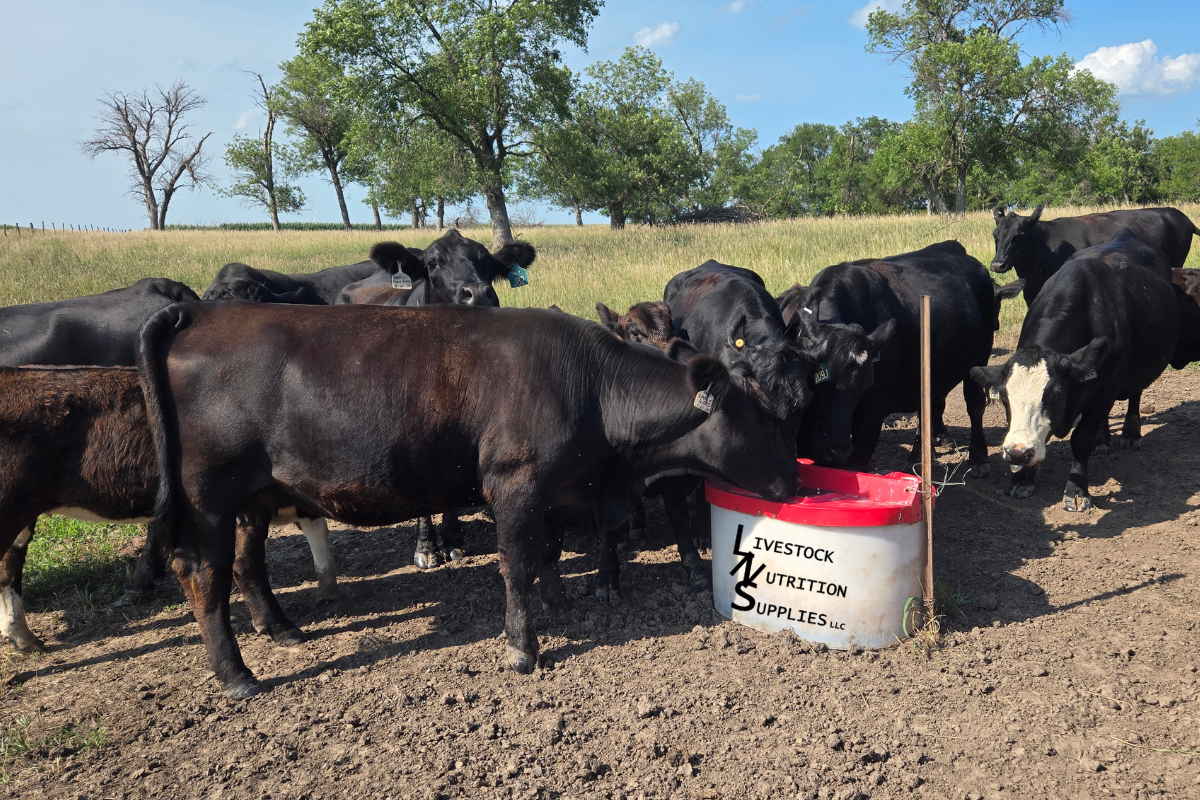
• Self-limiting liquid supplements: Liquid protein lick tanks
Combines protein, energy, and minerals in a consistent intake format. Particularly effective on large summer pastures where labor is limited. Intake is naturally regulated by molasses viscosity, lick wheels, and cattle behavior.
• Managed supplement feeding: Mixed or blended rations (confinement or drylot)
For dairy operations or intensive stocker programs, a balanced total mixed ration with corn silage, distillers grains, and a protein/mineral pack remains the gold standard for precision nutrition.
|
📱 INTRODUCING LIVESTOCK NUTRITION ANALYZER SYSTEM
Your On-Farm Nutritional Analysis Tool
Are you certain your summer supplement program is actually closing the gaps in your herd’s ration? LNAS is our web-based nutritional analysis platform developed specifically for beef and dairy producers, nutritionists, and veterinarians.
With Livestock Nutrition Analyzer System you can:
• Enter your specific class of cattle (beef or dairy), body weight, production stage, and target performance.
• Build a ration from a library of 280+ common feeds (or scan your own feed label) using actual dry matter composition values.
• View a live 22-nutrient analysis with visual status indicators showing deficiencies, marginal levels, and adequacy for CP, RDP, RUP, TDN, NEm, NEg, Ca, P, Mg, Se, Zn, Cu, vitamins, and more.
• Receive targeted product suggestions to fill identified nutrient gaps.
• Compare DMI projections based on NRC 2016 (beef) and NRC 2021 (dairy) requirements.
Access it free at: LNAS.Pro
Free Trial. Works on desktop, tablet, or mobile. Contact us for a guided walkthrough.
|
6. Your Summer Nutrition Action Plan
Use this checklist to evaluate and strengthen your herd’s nutritional program through the summer months:
• Pull a representative forage sample from your summer pasture and run a basic wet chemistry analysis (CP, TDN, ADF, NDF, P, Mg). Most co-ops and extension labs turn results in 5–7 business days.
• Enter your forage results and animal class into LNAS.Pro to instantly see how your pasture stacks up against NRC requirements — and which specific nutrients are short.
• Evaluate body condition scores on your cow herd now. Cows below BCS 4.5–5.0 heading into summer breeding are at risk of reduced conception rates and need supplemental energy AND protein.
• Check your mineral feeders. Are cattle consuming at the expected rate? Low consumption may indicate salt imbalance in the mix, palatability issues, or spoilage.
• Review water sources for sulfate and nitrate levels, especially in late summer when surface water quality tends to deteriorate. High sulfates can antagonize copper status significantly.
• Plan ahead for fall. Cows that exit summer in poor condition require significantly more resources to recover before calving. Prevention is far more economical than rehabilitation.
• Talk to your LNS representative or nutritionist about customizing your mineral and protein program based on your specific forages, water quality, and production goals.
|
We’re Here to Help
At Livestock Nutrition Supplies LLC, our goal is simple: to give producers, nutritionists, and veterinarians the tools and products they need to keep Livestock performing at their genetic potential — even when summer forages fall short.
Reach out to your LNS representative to discuss your summer program, or get a walkthrough of LNAS.Pro.
Livestock Nutrition Supplies LLC • Crete, Nebraska
Info@LivestockNutritionSupplies.com • (531)333-3150
|
This newsletter is intended for educational purposes. Supplementation recommendations should be reviewed by a qualified livestock nutritionist for your specific operation. |