|
Dear Valued Readers,
As spring pastures begin to green up, so does a serious but often overlooked danger—grass tetany, or hypomagnesemia. This metabolic disorder can affect a wide range of grazing livestock, including:
- Beef and dairy cattle (especially older, lactating cows)
- Sheep and ewes nursing lambs
- Goats, particularly during periods of rapid grass growth
These animals are most at risk when grazing on lush, rapidly growing pastures—typically in early spring or after a flush of regrowth in fall.
What Is Grass Tetany?
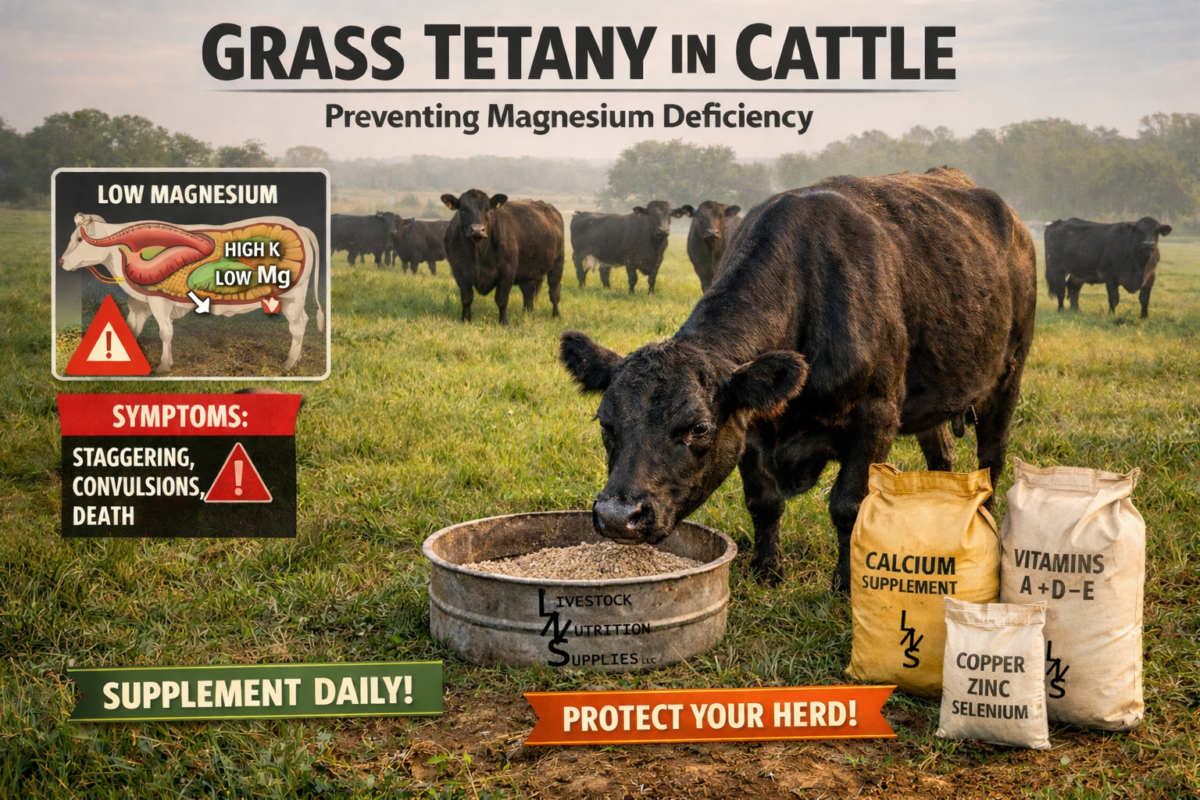
Grass Tetany, also known as grass staggers, wheat pasture poisoning, or hypomagnesemia, is a serious and often fatal metabolic disorder in cattle caused by critically low levels of magnesium (Mg) in the blood.
It most commonly occurs in:
- Early spring
- Fall regrowth periods
- Rapidly growing cool-season grasses such as ryegrass, wheat, and fescue
This condition can develop quickly and may result in death within hours if not prevented or treated.
Root Cause: Why Grass Tetany Happens
Grass tetany is not simply caused by low magnesium in the diet — it is primarily caused by reduced magnesium absorption due to pasture and forage conditions.
High-Risk Forage Conditions:
Fast-growing grasses often contain:
- Low magnesium
- High potassium
- High nitrogen
- High moisture
- Low fiber
These factors interfere with magnesium absorption in the rumen.
Potassium is especially problematic because it directly blocks magnesium uptake.
Fertilized pastures (especially with nitrogen and potassium) significantly increase risk.
According to guidance consistent with research standards, mature lactating cows grazing lush pasture have the highest magnesium requirement and highest risk.
Which Animals Are Most at Risk?
Highest Risk:
- Lactating cows (especially 30–90 days post-calving)
- Older cows
- Heavy milking cows
- Cows grazing lush pasture without supplementation
Lower Risk:
- Dry cows
- Young cattle
- Cattle receiving adequate magnesium supplementation
Effects of Grass Tetany on the Animal
Magnesium is critical for:
- Muscle function
- Nerve transmission
- Energy metabolism
- Calcium regulation
When magnesium drops, the nervous system becomes overstimulated.
Early Symptoms:
- Reduced appetite
- Nervousness
- Muscle twitching
- Stiff walking
- Separation from herd
Advanced Symptoms:
- Staggering
- Aggression
- Convulsions
- Collapse
Final Stage:
Death losses can occur in 2 to 12 hours after visible symptoms appear
Often, the first sign producers see is a dead animal.
Why Magnesium Supplementation Is Essential
Cattle cannot store large amounts of magnesium.
They must consume it daily.
Spring pasture alone does NOT provide enough available magnesium.
Supplementation is the only reliable prevention.
How Much Magnesium Is Required?
Target Total Diet Magnesium Levels:
|
Animal Type
|
Magnesium in Total Diet
|
|
Lactating cows
|
0.20% – 0.30%
|
|
High-risk conditions
|
0.30% – 0.40%
|
Typical intake target:
20 to 40 grams of supplemental magnesium per head per day
Timeline: How Fast Magnesium Supplementation Works
Understanding timing is critical.
Day 0: Begin Supplementation
Magnesium intake begins immediately.
However, blood magnesium increases gradually.
Day 1–2:
Partial improvement in magnesium status begins.
Protection is improving but NOT complete.
Risk still exists.
Day 3–5:
Significant improvement in blood magnesium levels.
Animals become substantially protected.
Day 7–10:
Full protective effect achieved.
Cattle are now properly protected assuming consistent intake.
IMPORTANT: Magnesium Is Not Stored Long-Term
Protection declines rapidly if supplementation stops.
Timeline if magnesium is removed:
|
Time Without Magnesium
|
Risk Level
|
|
24 hours
|
Protection declining
|
|
48 hours
|
Moderate risk
|
|
3–4 days
|
High risk
|
|
5+ days
|
Full grass tetany risk returns
|
Daily intake is essential.
How Long Should Magnesium Be Supplemented?
Supplement magnesium:
Begin:
At least 2 to 3 weeks BEFORE pasture turnout
Continue:
Throughout the entire high-risk period:
Typically:
- Early Spring: 60–90 days
- Fall regrowth: 30–60 days
Stop Only When:
Grass matures and slows growth
AND
Night temperatures consistently rise above 60°F
AND
Potassium levels decline
For most operations, supplementation lasts:
90 to 120 days annually
Best Magnesium Sources
Highly effective forms:
- Magnesium Oxide (most common and effective)
- Magnesium Sulfate
- Magnesium Chloride
Magnesium Oxide is preferred due to:
- High magnesium concentration
- Good rumen availability
- Cost effectiveness
Additional Critical Supporting Minerals
Magnesium works best when balanced with other nutrients.
Key supporting minerals include:
Calcium
Supports muscle and nerve function.
Works closely with magnesium.
Target:
0.6% – 1.0% of diet
Sodium (Salt)
Improves magnesium absorption.
Stimulates intake.
Salt should always be present.
Phosphorus
Supports energy metabolism.
Deficiency worsens grass tetany risk.
Potassium (Important Balance)
High potassium increases risk.
Supplementation cannot eliminate pasture potassium.
Proper magnesium intake offsets this risk.
Trace Minerals That Improve Resistance and Health
Include:
- Copper
- Zinc
- Selenium
- Manganese
These improve:
- Immune function
- Stress tolerance
- Metabolic efficiency
Vitamin Support
While vitamins do not prevent grass tetany directly, they improve metabolic stability.
Important vitamins include:
Vitamin A
Supports immune and epithelial health
Vitamin D
Supports calcium and magnesium metabolism
Vitamin E
Improves muscle and nerve stability
Reduces stress effects
Best Delivery Methods
Most effective supplementation methods:
· Free-choice mineral (most common)
· Protein tubs with added magnesium
· Fortified grain rations
· Free-choice mineral remains the most reliable and economical method.
Intake Target for Free-Choice Mineral
Typical target intake:
· 4 ounces per head per day
Providing:
· 20–40 grams magnesium
· Consistency is critical.
· Under-consumption reduces protection.
Key Prevention Summary
To prevent grass tetany successfully:
· Start magnesium 2–3 weeks before pasture turnout
· Supplement daily
· Continue for full risk period (90–120 days)
· Use high-magnesium mineral
· Ensure proper intake
· Maintain complete mineral balance
Economic Impact
Grass tetany can cause:
· Sudden death
· Lost calf production
· Lost genetics
· Lost income
· One death often exceeds the cost of supplementing the entire herd.
· Prevention is extremely cost effective.
How Livestock Nutrition Supplies LLC Can Help
Our mineral formulations are designed to:
· Provide optimal magnesium levels
· Maximize absorption
· Improve intake
· Support total herd health and performance
· Reduce risk during high-stress grazing periods
Final Takeaway
Grass tetany is:
· Rapid
· Deadly
· Preventable
· Magnesium supplementation is not optional during high-risk grazing periods — it is essential.
Proper mineral nutrition protects:
· Animal health
· Performance
· Profitability
Partner with Livestock Nutrition Supplies LLC
Our premium vitamin, mineral, probiotic, and garlic supplements are formulated for maximum bioavailability and performance. Whether you're feeding horses, cattle, hogs, sheep, goats, or poultry, we can help ensure your animals get the nutrients they need to thrive — and your operation gets the results you deserve.
Questions or need help setting up a mineral program tailored to your farm?
Contact your livestock nutritionist, veterinarian or local extension office—they're here to help!
Check out our High-Quality Vitamin, Mineral and Protein Supplements to help maximize your herds health. https://livestocknutritionsupplies.com/shop/
Stay informed, stay proactive, and together, let’s safeguard the well-being of our livestock.
Livestock Nutrition Supplies LLC
Info@LivestockNutritionSupplies.com
(531)333-3150

https://livestocknutritionsupplies.com/shop/
For any questions or further information, please do not hesitate to contact us. We’re here to help you provide the best care for your animals.
|